An Idiot’s Guide to Ski Jumping: Summer Jumping

Ski Jumping is one of the 16 original Winter Olympic events. It is often referred to as “the original extreme sport.” Despite its rich history, most people don’t know what ski jumping is, and almost no one understands it. If you fall into either of these categories, then this series is for you. Click here to view other articles in this series.

When people hear Ski Jumping, they envision a skier jumping on snow, which is true in the winter. In the summer, however, ski jumpers can still jump. How?

In the summer, the ice and snow melt off the inrun, revealing the summer plastic tracks below. The summer tracks have round bumps on the bottom that reduce friction between the skis and the track. The bumps, combined with a system of misters that spray down the track, “make it feel almost exactly like snow,” says Jack Kroll ’26.

Ski Jump summer tracks. Photo by Everslide.com

Snow nets are being installed on the 90M at the Lake Placid Olympic Jumping Complex. Photo by Lake Placid Legacy Sites.

For the landing hill, it is a little more complicated to go from winter to summer jumping. When the snow melts, it reveals large snow nets that cover the entire landing hill. These are massive cargo nets attached to the concrete beneath the landing hill, preventing snow from sliding off the slippery summer landing. The nets must be removed before summer jumping can start. The summer landing hill consists of plastic sheets with nylon bristles that resemble weed-whacker string. The sheets are roughly 2 feet long, and they overlap each other down the landing hill like shingles on a roof. On the side of the hill, there is a sprinkler system that waters down the plastic. These sprinklers are turned off while someone is jumping, as they interfere with the flight. Then, there is a water break when the plastic gets too dry. If the plastic is dry, there is a lot of friction between the skis and the plastic, which can cause the jumper to stick to the landing hill and fall.

Snow nets installed at the Olympic Jumping Complex. Photo provided.

Summer jumping makes Ski Jumping a year-round activity. Northwood Ski Jumpers can train on the hill for all but three and a half months a year. Northwood Ski Jumpers are extremely lucky, as they get to call one of the two American Olympic-sized jumping complexes their home hill in the summer.

An Idiot’s Guide to Ski Jumping: The Phases of Ski Jumping

Ski Jumping is one of the 16 original Winter Olympic events. It is often referred to as “the original extreme sport.” Despite its rich history, most people don’t know what ski jumping is, and almost no one understands it. If you fall into either of these categories, then this article is for you.

Before every practice or competition, athletes must prepare. They spend substantial time warming up and preparing for a jumping session. Northwood ski jumper Henry Loher ’26 says, “First, I wax my skis, then I go for a short run. Then, I play one bounce,” (the American ski jumper version of a popular Norwegian soccer game). “Once we finish one bounce, I go and stretch for ten to twenty minutes. Then, I do some plyometrics and balance work with my coach. When my coach gives me the ok, I go and suit up.” Once suited up, athletes head up the jump and put their skis and jets on. For more on equipment, click here. Then, they slide out onto the bars. Now for the actual jump.

First is the in-run. When an athlete gets on the bar, a coach will put their hand up. The coach watches the wind and waits for the right, safe conditions. The coach waves their hand, and this is the athletes’ signal to go. They then get off the bar and into an in-run position. This is a low-aerodynamic tuck position that athletes use to gather speed and prepare for takeoff.

USA Ski Jumping National Team and NYSEF Alum Tate Frantz is in an in-run position while warming up. Photo provided.

The second phase, the takeoff, is the most critical. Jumpers need to push straight down through the ball of their foot. If a jumper rolls off their toes, the ski tips go down. Jumping skis are designed to catch a lot of air, and when that air is caught on the top of the skis, the skis fall away, and the jumper flips over and crashes. If a jumper jumps off their heels, the skis pop up, and they catch a lot of air. This acts like a brake, reducing all the jumpers’ speed, so they travel less far. Ski jumpers are trying to find a balance between generating lift (positive ski angle) and maintaining speed without lift (flat ski angle). Notice the shin angle in the image of the inrun. This is extremely important as it allows jumpers to jump not just up but also out, maintaining their speed. The takeoff also has a timing component. Ski jumpers are moving 55+ MPH on the Olympic-sized hills in Lake Placid. This makes perfectly timing a jump very difficult. Many people think there is a lip or jump at takeoff, but it is at a negative angle, which is why timing is essential, since all of a jumper’s power and trajectory are self-created.


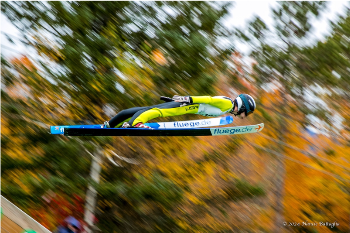
The third phase is the flight, which continues the takeoff. Jumpers try to be aggressive and out over their skis. The goal is to be nearly parallel to the ground. The skis are in a V position, increasing effective length by up to 30% compared to traditional parallel skis.

Henry Loher ’26 in flight at the 2024 US Nationals. Photo by Nancie Battaglia.

The fourth and final phase is the landing. Landings are scored by judges on the side of the hill. For more on style points and judges, click here. The ideal landing is the telemark landing, with one foot in front of the other and hands out to the sides. Then, athletes slow down as they go up the counter slope and are ready to go back up and jump again.

Humans of Northwood: Clara Boutelle ‘26

“Being a Lake Placid local, there are really only two paths to take. I felt like I had evolved past the public school environment; I was ready for a new chapter and looking for a fresh challenge that would push me further.

“I started at Northwood at the beginning of my junior year. My first impression was immediately how different the environment is from the public school in Lake Placid. The level of freedom here is vastly different, and I quickly realized that succeeding at Northwood requires much more self-motivation and personal structure than I was used to.

“I’ve actually been a ski racing coach at NYSEF for four years now. I was a competitive ski racer for a very long time, and when that career ended, I knew I wanted to stay connected to the sport. I coach the U10s—mostly little girls—and while it’s definitely a challenge to wrangle them, it is so much fun.

Next year, I’ll be moving to Washington, D.C., to attend American University. I plan on pursuing Political Science, likely with a minor in Anthropology, while continuing my Italian studies. Beyond that, my future goals aren’t set in stone yet, but I’m excited to see where those fields take me.

“I’ll miss the friends I’ve made and the teachers who have become more like mentors. Specifically, Mr. Shergold has been a huge part of my academic career here and someone I’ve truly appreciated having in my corner.

“My favorite memory is the process of writing my college essay with Reno. I remember writing a first draft that he really didn’t like. I went back to the drawing board and came back with something he ended up loving. It was a great experience to have someone recognize my writing talent in that way. That essay, along with a piece I wrote about my experience in Uganda, is being published in the Northwood magazine—both pieces are special to me because of the connection and guidance from Reno.

“I’d like to give a huge thank you to Mr. Shergold, Reno, and my friend Uma for making my time here what it was.”

As told to Jack Kroll ’26. Photo by Mr. Michael Aldridge.

Humans of Northwood: Leanne Aubut Laurin ’26

“I came to Northwood two years ago to try to balance my academics with my sport. I do alpine ski racing for NYSEF and Northwood.

“I’m from Quebec, Canada, and my first language is French. Before coming to Northwood, I was already bilingual, which helped with my transition. For some classes, it was still hard, though.

“My favorite thing about Northwood, besides my friends, is the fires outside and in the living room. Also, playing cards in the living room. I love hanging out with my friends, going into town, and playing golf. Also, Spikeball in the Fall and Spring is one of my favorite things.

“We have one last race this season. It is called The Springs, and it’s gonna be pretty fun. It is in Quebec, and then it’s gonna be after spring break, and then the season’s over. Unfortunately, I’m missing the Alumni race because it’s over break.

“For next year, I just got accepted to Babson, which is right outside Boston, so I might just go there. If I do, I will be on the D1 ski team there.

“I mean, it’s Babson. It is an amazing, busy school, and that’s what I want to do.

“Many people don’t know, but I love cooking, and I’m actually really good at tennis.

“Pineapple kind of belongs on pizza. Only if it’s the right pizza does it; if it’s good, then it belongs.

“
For next year’s Seniors, enjoy every moment, because everything goes by really fast. Also, do your college essay during the summer because you will have a lot of schoolwork in the fall, and it’s hard to do your essays at the same time.”

As told to Jack Kroll ’26. Photo by Mr. Michael Aldridge.

Senior Splashin’

Senior Splashin’ is a game that is quickly becoming an American high school staple as a key part of the senior experience. Last year, it made its way to Northwood, and the class of 2025 had 52 participants. Many cited how it “brought our class closer together,” Sydney Kuder ’25.

For those who don’t know how the game works, seniors use a join code to join the Northwood game in the Splashin’ app. Once the game starts, every participant is assigned a target to eliminate using water. Water guns, water balloons, water buckets, and even water bottles are allowed as long as the target gets wet and the event is filmed. Many rules were added to ensure safety and prevent interruptions to class. There is a series of rounds, and at the end, the last student standing wins. The catch is that at the same time, someone is targeting you, and you don’t know who it is. It could be someone you have never met, or your best friend. This is the beauty of the game as it brings seniors close together one last time before graduation, creating stories, memories, and friendships that will last a lifetime.

Last year, Sophia DeAnzeris ’25 said, “Senior Splashin’ has done a great job of bringing us together over the past few days. Especially because the targets are random, so it’s not always just people within your co-co. Making this a tradition would be great for seniors in the spring since it not only allows for fun competition among the class but also brings us together for the last few weeks of the year.”

The class of 2025’s hope of making Splashin’ a tradition has now become a reality as the class of 2026 brought it back for a second year. The game is scheduled to start on Monday, April 20th. There are currently 44 players signed up, but game organizers Charles Pigeon ’26 and Jack Kroll ’26 are “optimistic that the number will grow before the games start.”

“I’m very excited for it to start. Last year, it looked like everyone had a lot of fun. I’m hoping this year people are just as competitive and take it seriously,” Anna Monette ’26 said.

This year’s field also includes some repeat players: members of the class of ’25 who returned as PGs. One of the repeat players is last year’s Co-Champion, Florence Richard ’26. “I think I might repeat but with different rules and different alternatives just to make it stand out, but it did certainly bring the class together and bring a sense of community, and everybody was just happy to do it and was all done with a good heart and people having fun, so definitely shows how just a simple game can bring everybody together.”

For updates on the game and all elimination clips, follow nwseniorsplashin on Instagram.

Nordic and Ski Jumping Junior Nationals

Before spring break, Northwood cross country skier Max Fey ’28 and ski jumper Islay Shiel ’28 wrapped up their seasons competing in their respective Junior National Championships.

Max traveled to Cable, Wisconsin, for the 2026 Nordic Junior National Championships. He made the team after showing strong results at the qualifiers throughout the season.

In Nordic, athletes compete in multiple races divided by both distance and technique.

Max started the week with 4th place in the U16 5km freestyle race. Then he had the sprints, which, unlike most Nordic races, had multiple heats and rounds leading up to the final. You must place on top of your heat or have a fast time to move on.

Max Fey ’28 is on the top 10 podium at Junior Nationals. Photo provided.

“In the sprints, I got seventh place, but it was my greatest top ten yet. I made heats and had no trouble in quarterfinals, but when semis rolled around, I got tangled up with a couple of the other racers and fell far behind. I tried to regain contact, but I had no kick, and at that point, the race was over. I got fifth in my heat, bumping me out of final contention. I made B finals, and instead of being all bummed about not making A finals, I raced it as hard as humanly possible and won by quite a large margin. Although it was not the result I was looking for, it was my proudest race at JNs,” Max said.

These two results landed Max All-American honors in both races.

At the same time, Islay Sheil ’28 was across the country in Steamboat Springs, Colorado, for Ski Jumping Junior Nationals. She flew there straight from Norway, where she was competing in the Junior World Championships.

Islay finished 2nd in the U20 girls’ class at Junior Nationals, which is “my best national finish yet. It was also a super fun trip and competition,” said Islay.

Islay Sheil ’28 is flying at Junior Nationals. Photo by Gary Christie.

Humans of Northwood: Marie-Jeanne Cazes ’26

“My advice: get your Common App done as fast as you can. Why?

“Well, I grew up in Quebec City, and it’s been like 10 years since I started ski racing. I started skiing at three and started racing at 8. I came to Northwood because of Leanne. We were really close, and she told me she was coming here and that I should come. So, I emailed the coach, and he said I should visit.

“I came here as a senior, and I really wanted to go to college in the U.S. However, no one told me when I got here how important the Common App is to get into college. Also, I wasn’t ready yet, so I decided to PG.

“Two years ago, I was doing all my schoolwork in French, and at Northwood I had to switch to English. My grades improved as I learned English, and during the second year, I got to know the teachers, which really helped me. I raised my grades, which helped me get into Babson next year.

“Switching from living in my house, being in another country, and speaking another language really made me grow.

“Seniors, just enjoy your last year here. Try to make as many friends as you can. I will miss my friends and the social life here. Here, you’re close to everyone and make good friends. Just being in the living room, talking to people, playing the piano, sitting by the fire, going to the games, and in the Spring, hanging out with everyone and going to the lake. I’m going to miss all of it.

MJ’s recent art project. Photo provided.

“I do not think pineapple belongs on pizza. I think I’ve never actually had one. So, I’m against it. My favorite meal in the dining hall is grilled cheese and tomato soup.

“During my free time or when I’m bored, I do art just to relax. I think it’s because of my mom. My mom is an architect, and since I was really young, I drew houses with her. I like drawing with her, and that’s maybe why I’m good at it.”

As told to Jack Kroll ’26 while working on her latest art project. Photo by Mr. Michael Aldridge.


Brattleboro Preview – Ski Jumping and Nordic Combined Junior World Championship Qualification

This coming weekend, February 13th – 15th, Northwoods ski jumping and nordic combined teams head to Brattleboro, Vermont, to compete in the second set of Junior World Championship Qualifiers. They will compete on both Saturday and Sunday for spots on the U.S. Junior Worlds team, with Saturday’s also serving as a US Cup competition – the highest level of domestic competition. 

The Junior World Championships are the highest level of U20 international competition in both ski jumping and nordic combined. Each nation chooses their top 4 junior athletes as well as an alternate for each sport to send to the Championships. This year, the Championships will take place in Lillehammer, Norway, site of the 1994 Winter Olympics.  

The first two qualifiers were in Ishpeming , Michigan. Henry Loher ‘26 won both competitions and is leading the standings for the three remaining spots. Jack Kroll ‘26 took 4th  in the first qualifier and 2nd in the second. Kroll is tied with Arthur Tirone from Steamboat Springs, Colorado, for the final two spots. For nordic combined, Duncan Van Dorn ‘28 placed 4th in both competitions and currently holds one of the 5 unclaimed nordic combined spots.  

Athletes during the National Anthem in Brattleboro – Harris Hill.

This is the biggest weekend of the year for the team. Loher, Kroll, and Van Dorn will look to solidify their position on the Junior Worlds team, while athletes like Eli Larkin ‘27 and Islay Sheil ‘28 aim to close the gap and move into a qualification position.  

Supporters can tune in to the competition via live stream. On Saturday, 02/14, the live stream starts at 11am, with the competition starting at 12pm. On Sunday, 02/15, the live stream  starts at 11am, with competitions beginning at 12:30pm

They Train Like Olympians. They Compete Like Olympians. They Aren’t Allowed to Be Olympians.

The Olympic Dream, Denied: Women and Nordic Combined. 

The International Olympic Committee has dubbed the 2026 Milano Cortina Winter Olympics the most gender-equal Winter Olympics in history, with women’s competitors making up 47% of the field. This figure is the result of decades of advocacy by athletes and fans pushing for equal opportunity across genders; however, the IOC still refuses to give the women of Nordic Combined their opportunity. 

Nordic Combined is a sport combining ski jumping and cross-country skiing. It is one of the original Olympic sports and has been contested at every Winter Olympic Games—but only for men. 

In the last decade, women’s Nordic Combined has grown rapidly, with the addition of the World Cup in 2020, which was won by Vermont native Tara Geraghty-Moats, and the addition of a large hill event in March 2025. Despite this progress, one stage still excludes women: the Olympics. 

The International Olympic Committee cites a lack of diversity on the World Cup podium, a lack of viewership, and a lack of development in the sport as reasons the women’s event is not included. 

Here are the facts. So far, athletes from five separate nations have stood on the podium in the 2025–2026 World Cup season. This includes American athletes Alexa Brabec and Tara Geraghty-Moats. As for viewership, during the 2024–2025 World Cup season, viewership of women’s Nordic Combined events grew by 25%. 

The lack of growth in the sport is directly tied to its absence from the Olympics. Every young athlete shares the same dream: to become an Olympian. When a young girl is choosing a sport, she isn’t going to choose the one in which she is denied the chance to fulfill that dream. Additionally, by excluding women from competing in Nordic Combined, the IOC is failing to uphold one of the goals laid out in its charter. Founder Pierre de Coubertin stated, “The Olympic Games are open to all the world. No discrimination is allowed.” 

This is not a new story. Since the very first Winter Olympics, certain sports and events have been open only to men. Over the course of a century, athletes and fans pushed back. Eventually, only two holdouts remained: ski jumping and Nordic Combined. In 2014, women’s ski jumping was added to the Winter Olympics, leaving Nordic Combined as the Winter Olympics’ last holdout. 

Now it is time for us—the athletes, the fans, and everyone who believes in the Olympic dream—to speak up. Every year without women’s Nordic Combined at the Olympics sends a clear message to young girls watching from the sidelines: this dream is not for you. That message contradicts everything the Olympics claim to represent. Equality cannot be selective. Opportunity cannot be conditional. The women of Nordic Combined have earned their place.

NO E❌CEPTION Campaign Poster by Jack Kroll and Nordic Combined USA.

History will not remember the excuses used to delay equality; it will remember who stood in the way of it. The Olympics pride themselves on progress. It’s time they prove it. No more waiting. No more excuses. No exception. 

What Can You Do? 

Change does not happen quietly. A petition supporting the inclusion of women’s Nordic Combined in the Olympic Games is linked here for readers who want to add their voice. Fans can also support the sport by tuning in to men’s Nordic Combined at the Olympics. Strong viewership of the men’s event increases the likelihood that the IOC will add the women’s event. Here’s where and when to watch men’s Nordic Combined at the Olympics. 


Sign the Petition to Include Women’s Nordic Combined in the Olympic Games!

Where and When to Watch.

Faculty Apartment Tour: Dr. Ben LeBlanc

Dr. Ben LeBlanc at his apartment door. Photo by Jack Kroll ’26.

Today, we take a rare look at one of the apartments that Northwood faculty and staff call home. Dr. Ben LeBlanc has taught at Northwood since 2021, living on Third East the entire time.

When you first walk in, one thing is immediately clear: LeBlanc loves to run. The main hallway is lined by racks of running shoes, bins of running hats, and hanging running coats. The shoe collection used to be much larger, he said; last year, he donated 120 pairs of shoes to a fundraiser led by former teacher and soccer coach Mr. Martinez. The shoes went on to help kids in Honduras. LeBlanc runs an average of 3,000 miles a year, which is why he goes through so many pairs of shoes.

Ben LeBlanc’s main apartment hallway. Photo by Jack Kroll ’26.

Racks of running shoes in LeBlanc’s apartment. Photo by Jack Kroll ’26.

Racks of running shoes in LeBlanc’s apartment. Photo by Jack Kroll ’26.

Leblanc also has a spin bike in his apartment for when he needs a break from running or when it’s too cold outside. He also has a road bike that he uses in the summer to get more base endurance hours.

Like any good athlete, LeBlanc emphasizes recovery after training. In his apartment, he has foam rollers, resistance bands, and an ankle-stretching device. He also has his own set of Normatecs similar to those Donny has in the training room.

LeBlanc’s spin and road bike. Photo by Jack Kroll ’26.

LeBlanc’s recovery tools. Photo by Jack Kroll ’26.

Leblanc’s dog, Ellie, has her own special spot in the apartment. She has two dog beds perched on a coffee table in LeBlanc’s living room. Ellie also has a massive Pikachu stuffed toy that is her favorite. She’s also featured in artwork around the apartment.

Also in LeBlanc’s living room is a desk that he uses to check the physics subreddit, as well as a kitchen. LeBlanc eats his main meals in the dining hall, but he occasionally cooks in his kitchen.

Photo by Jack Kroll ’26.

Photo by Jack Kroll ’26.

Ellie, LeBlanc’s beloved Frenchie. Photo by Jack Kroll ’26.

Outside of the living room, he has a laundry room, a small bathroom, and a bedroom.

Dr. LeBlanc’s desk. Photo by Jack Kroll ’26.

Dr. LeBlanc’s bedroom. Photo by Jack Kroll ’26.

Dr. LeBlanc’s laundry room. Photo by Jack Kroll ’26.


The Mirror was established in 1927
© 2015-2022 by the Staff of The Mirror
The Mirror's Policy Manual and Style Guide.
The Mirror is funded by gifts to the Northwood Fund. Thank you.