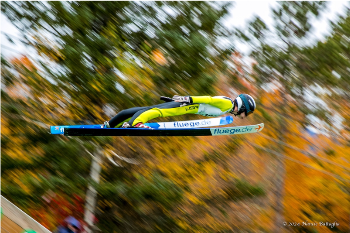
Ski Jumping is one of the 16 original Winter Olympic events. It is often referred to as “the original extreme sport.” Despite its rich history, most people don’t know what ski jumping is, and almost no one understands it. If you fall into either of these categories, then this article is for you.
Before every practice or competition, athletes must prepare. They spend substantial time warming up and preparing for a jumping session. Northwood ski jumper Henry Loher ’26 says, “First, I wax my skis, then I go for a short run. Then, I play one bounce,” (the American ski jumper version of a popular Norwegian soccer game). “Once we finish one bounce, I go and stretch for ten to twenty minutes. Then, I do some plyometrics and balance work with my coach. When my coach gives me the ok, I go and suit up.” Once suited up, athletes head up the jump and put their skis and jets on. For more on equipment, click here. Then, they slide out onto the bars. Now for the actual jump.
First is the in-run. When an athlete gets on the bar, a coach will put their hand up. The coach watches the wind and waits for the right, safe conditions. The coach waves their hand, and this is the athletes’ signal to go. They then get off the bar and into an in-run position. This is a low-aerodynamic tuck position that athletes use to gather speed and prepare for takeoff.

The second phase, the takeoff, is the most critical. Jumpers need to push straight down through the ball of their foot. If a jumper rolls off their toes, the ski tips go down. Jumping skis are designed to catch a lot of air, and when that air is caught on the top of the skis, the skis fall away, and the jumper flips over and crashes. If a jumper jumps off their heels, the skis pop up, and they catch a lot of air. This acts like a brake, reducing all the jumpers’ speed, so they travel less far. Ski jumpers are trying to find a balance between generating lift (positive ski angle) and maintaining speed without lift (flat ski angle). Notice the shin angle in the image of the inrun. This is extremely important as it allows jumpers to jump not just up but also out, maintaining their speed. The takeoff also has a timing component. Ski jumpers are moving 55+ MPH on the Olympic-sized hills in Lake Placid. This makes perfectly timing a jump very difficult. Many people think there is a lip or jump at takeoff, but it is at a negative angle, which is why timing is essential, since all of a jumper’s power and trajectory are self-created.
The third phase is the flight, which continues the takeoff. Jumpers try to be aggressive and out over their skis. The goal is to be nearly parallel to the ground. The skis are in a V position, increasing effective length by up to 30% compared to traditional parallel skis.

The fourth and final phase is the landing. Landings are scored by judges on the side of the hill. For more on style points and judges, click here. The ideal landing is the telemark landing, with one foot in front of the other and hands out to the sides. Then, athletes slow down as they go up the counter slope and are ready to go back up and jump again.