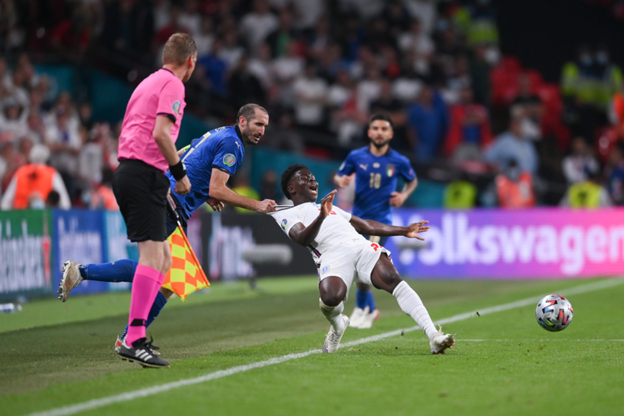
The average soccer match features more than 20 fouls, a handful of yellow cards, and the occasional sending-off (red card). To casual sports fans, differentiating between a caution and a card-worthy offense is likely pretty difficult. After this article, this won’t be an issue; here is an “idiot’s” guide to fouls and cards.
FOULS

On average, the referee will blow his whistle every 5 minutes to signal a stoppage in play due to a foul. When a foul occurs, two things happen: First, the referee blows his whistle, signaling foul play. Second, he (the referee) may have a quick word with the culprit; usually, he will remind the player to keep a cool head and warn him that further foul play could earn him a card. Things such as shirt-tugging, mistimed tackles, and impeding a player’s movement are all forms of foul play and will earn a player a stern talking-to (these actions can also be yellow and red card offenses, and I will explain how this can be the case later on).
Note: Fouls are most common at the start of games, as the referee needs to establish control. Sending the message to both teams that foul play will not be tolerated.
Yellow Card

As I previously hinted, yellow card offenses are not so different from regular fouls; the difference lies in the intent and context of the situation. If a referee deems a *challenge as reckless, or that the player does not show clear intent to play the ball, or that there is any other disingenuous intent, that player has earned himself a **booking. For example, if a player flies into a tackle at high speed, severely mistiming it and clattering into the opponent, the referee has good reason to deem the challenge reckless and issue a yellow card as punishment. A second example is when a player grabs an opponent’s shirt to hold them and prevent them from maintaining possession of the ball; this kind of infraction is called a “tactical foul”. A tactical foul usually occurs when a team is being counter-attacked and outnumbered in defense. In this situation, a player from the defending team will intentionally grab or trip up an opponent to stop play; the goal isn’t to win the ball, but to stop the attack.
In short, a yellow card offense will live up to one of the two criteria: Either it was a reckless decision, or the play made no real or honest attempt to play the ball.
Note: A yellow card means the player is now walking on thin ice, as another yellow will earn him a sending off. Yellow + Yellow = Red.
Note: A player can also receive a yellow card for taking their jersey off after scoring a goal.
*A challenge is a footballing term that essentially means “tackle”.
**Every referee has a little booklet in their front chest pocket, which, among other things, is used to note down players who have been disciplined. So, to be “booked” means earning yourself a yellow or red card.
Red Card

In the game of football, there is no more game-changing event than when a player is sent off. Unlike in other sports, where you can replace the dismissed player, a red card in football means that the receiving team must play a man down for the remainder of the match. This man’s disadvantage forces teams to change their game plan; if a midfielder or defender is sent off, teams must take off an attacker to plug the hole in defense, and they can’t afford to take risks. A man-down causes the affected side to play an ultra-defensive style of football, in which all 10 players are compact and behind the ball (think of their defensive shape as a bus parked in front of the goal.
A Red Card is reserved only for when the referee deems that a player has used excessive force, endangered the safety of an opponent, or denied the opponent a clear goal-scoring opportunity. The most common situations where the card is brandished are when a player severely mistimes a slide tackle from behind or goes into a tackle with his studs up, targeting the ankle or upper leg.
Summary
Next time you are watching a game of football (soccer), here is what you should think about when the referee whistles for foul play: Was the tackle reckless? Was there a genuine attempt to play the ball? Was it a dangerous challenge? If any of the answers to these questions are yes, you can be confident in knowing that the player earned himself a card – and whether the referee brandished one or not – you made the right call.